

Framing the enterprise Agentic AI adoption challenge
A 2-by-2 grid wit 5 factors of evaluation

Organisations looking to adopt Agentic AI are immediately faced with the questions of “what exactly to do” and “how to do it” (whatever “it” is). The problem is, the field of Agentic AI is moving at a breakneck speed. New models, frameworks and use-cases seem to pop up every week. It seems as if the world is moving on to a new age and an organisation has to do everything all at once or its competitors will pull ahead the moment it is one step behind the frontier. And while the benefits are likely real, Agentic AI also brings with it its own set of challenges.
On top of that, the organisation still has to answer for itself the question of how real are the benefits of Agentic AI to itself. This is something that is specific to the circumstances of the organisation in question and can only be answered by actually trying to adopt Agentic AI in its actual business operations.
In this blog post, I offer up my way of thinking through enterprise Agentic AI adoption. I don’t offer answers per se, as each organisation is unique. But I think what I have here is a way of thinking through the problem and helping an organisation prioritise its Agentic AI adoption efforts.
Challenges of Agentic AI
Agentic AI brings comes with its own challenges. Some of them are unique. Some of them are challenges that are also present in conventional AI applications but have morphed into “a different animal” due to the explosion in intelligence brought about by Large Language Models (LLMs). Here’s a few of them:
Lack of determinism. Unlike Robotic Process Automation (RPA) where business processes were automated based on deterministic descriptions of how the process is supposed to go (basically “if-this-then-that”), AI agents can potentially make decisions on their own and roam around the organisation. The decisions made by these AI agents are mediated by LLMs, which are themselves non-deterministic. This means that you cannot guarantee that you get the same response each time. This is unlike the software-enabled processes that we all know so well that still allow organisation to trace, track and understand how business processes go from one step to another at scale. At this moment, this is still an area that organisations struggle with. And obviously, this can have dramatic business impact, considering that you can no longer predictably understand the business outcomes across the millions of interactions you might have with your customers.
AI agents can work 24/7 at a much larger scale than humans. This means that any mistake or misconfigured access rights can result in drastically larger damage as compared to when humans are the chief mediators of tasks. Imagine if an AI agent handling customer refunds were to return 10 times more money than required each refund. Without the right organisational and technical guardrails, the losses could be astronomical before anyone notices.
AI agent identity and accountability. AI agents will be able to access organisational data resources and take actions on behalf of the company. There needs to be a good way to identify which AI agent accessed which organisational resource and also who, if anyone, was directing the agent. If an AI agent inappropriately accessed customer data, who is then accountable? Is it the person who built the AI agent? Or the person who gave the direction to the AI agent? What if the AI agent was autonomous and no one was giving it directions at that moment? Since the reasoning capability of the AI agents come from the LLMs, would the LLM providers be liable if the AI agent made a wrong decision? One can see how this might expose the organisation to legal repercussions if the AI agent were dealing with customers on its behalf.
Token economics. Before Agentic AI, you developed a model, you hosted it, you paid for the infrastructure that you hosted the model on. Simple. Now, you basically pay for every single interaction and every word that was exchanged, if you relied on the frontier labs who own and provide the LLMs. On top of that, Agentic AI brings token usage to a whole new different level from the early days of ChatGPT, where it was more a single user to-and-fro conversation. Every AI agent can spawn sub-agents. Each agent / sub-agent starts with a fresh context, which means using up a bunch of tokens to get information, and to complete the task assigned to it, which means using more tokens. Each agent “thinks” more, which again means more tokens used. An organisation can of course choose to host its own LLM and constrain the costs to infrastructure costs. But LLMs providing frontier reasoning capabilities are beasts on their own and to host one’s own LLM serving an organisation of thousands (if not more) is no trivial matter.
There are of course many more challenges such as IP ownership. But I shall not go any deeper as I want to move on to the discussion of the enterprise framework that I think will help organisations mitigate the risks of Agentic AI adoption.
The Framework
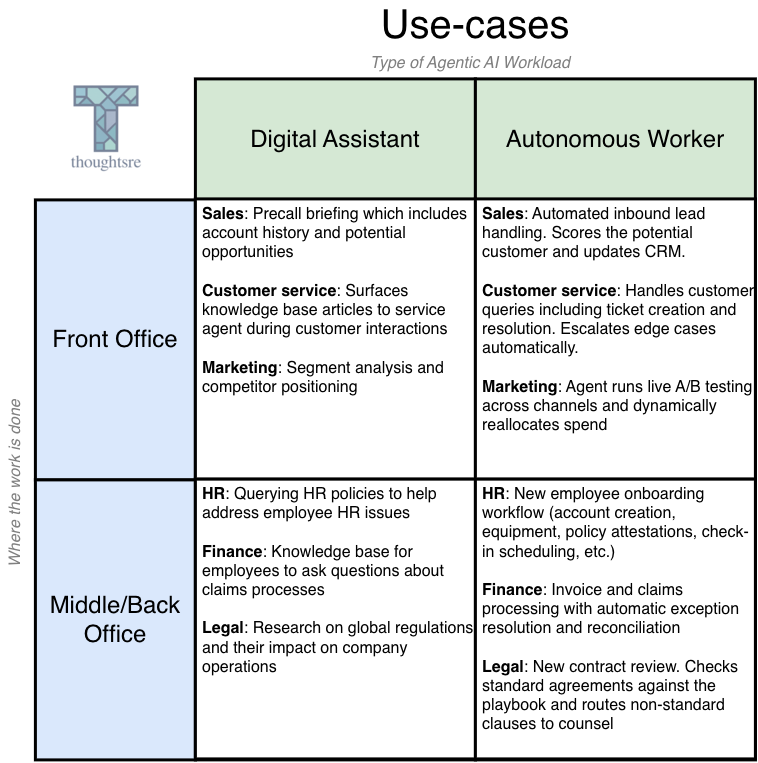
In my mind, I divide the Agentic AI application world into a two-by-two grid spanned by the axes of the type of workload (Digital Assistant vs Autonomous Worker, columns, in the diagram below) and where the work is done (front office vs middle/back office, rows, in the diagram below).
The second axis is obvious. But perhaps the first axis enumerating the type of workloads requires a bit more definition.
Digital Assistant
Helps individual workers raise their daily productivity
Can be highly customised to individual work habits
Claude Cowork, Microsoft Copilot and ChatGPT are typical “digital assistants”
Claude Code, Grok Build, and GitHub Copilot are “digital assistants” for developers
Autonomous Worker
Agentic AI replacements of end-to-end business workflows
Basically AI agent workers
Has access to enterprise data systems and make decisions of how the workflow progresses from one step to the next
Highly customised. Built using LLM harness frameworks like Strands Agents, Google ADK and LangChain
The table below shows typical use-cases for each of the four quadrants. Note that “Front Office” differs from organization to organization. If you work in a scientific R&D organization, then “Front Office” would include R&D which would usually be “Back Office” for normal commercial companies.
Factors of evaluation
Armed with this 2-by-2 table, you can evaluate your enterprise adoption of Agentic AI using various factors. Five of them come to mind for me usually:
Time-to-impact
Blast radius
Reversibility
Technology requirements
Net impact potential.
Time-to-impact
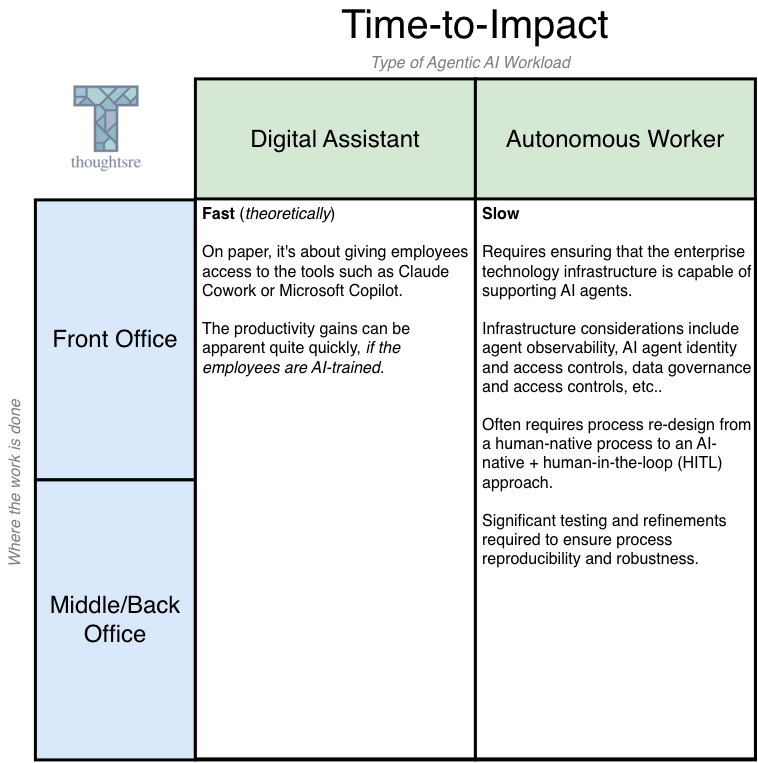
Time-to-impact looks at how fast you can expect to see changes in your organization. For this factor, the difference lies in the type of Agentic AI workload. The digital assistant type of workload is theoretically faster since it's mostly about enabling access to commercial tools. I say “theoretically” because there are other factors such as organization culture or level of AI training given to employees that will affect how fast AI’s impact can be seen.
Blast Radius
The blast radius measures the size of impact to the organization when things go wrong. The quadrant to call out here is the Front Office - Autonomous Worker, where there is no employee “buffer” between a company and its customers. Since AI workers theoretically can work 24/7, a company can rack up quite a lot of customer incidents before anyone notices, if proper circuit breakers/guardrails are not put in.
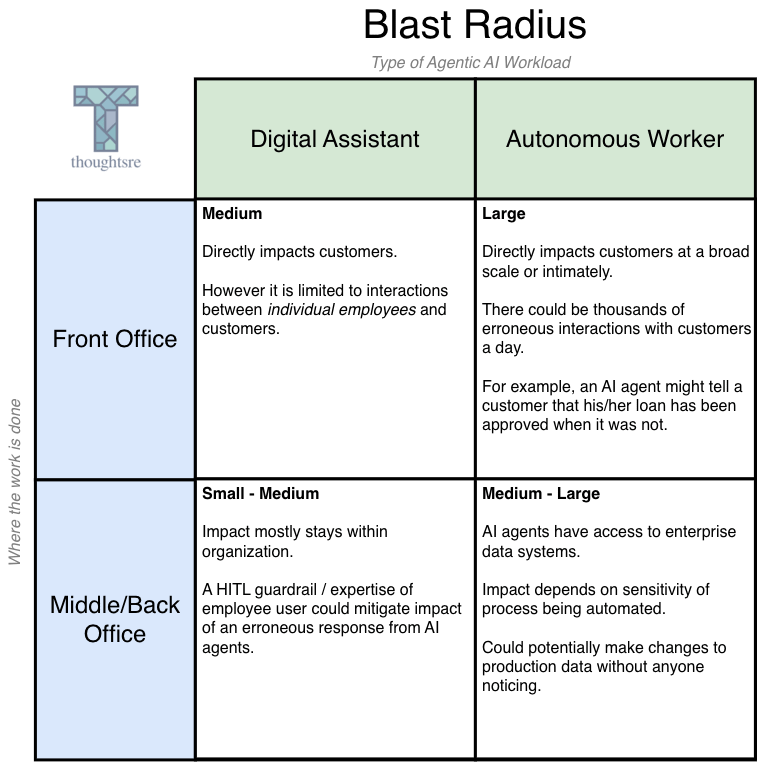
That being said, blast radius sometimes cuts both ways. The fact that a use-case has a large blast radius, sometimes also means that the benefits are greater if it is successful. Nonetheless, the larger the blast radius the more reason to be extra careful.
Reversibility
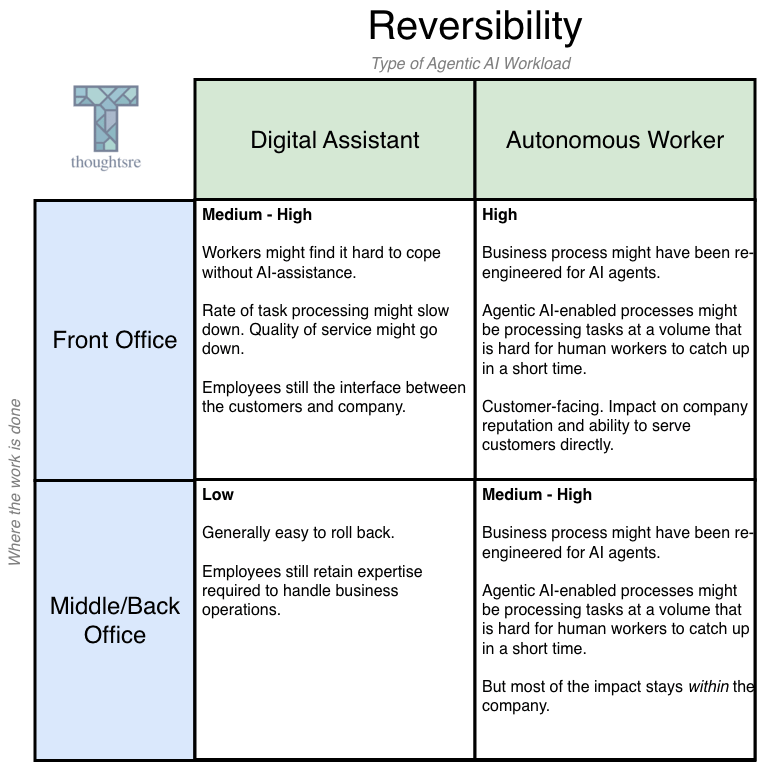
Reversibility is about how easy an organization can take away the AI agents that were implemented. The need to reverse changes could be because the organization found out that AI agents don’t actually generate the economic value that it thought AI agents would. Or it could be due to regulatory changes, such as the recent decision by the Monetary Authority of Singapore to include AI agents in its governance framework, that makes an organization decide that its not worth the risk of regulatory violations.
On the digital assistant column, it is generally easier to reverse changes as employees should still retain the domain knowledge to keep the business going. (That may not be true if an organization’s employees have become totally dependent on AI) The same cannot be said for the Autonomous Worker column as business processes might already have been re-engineered to be AI agent-centric.
Technology Requirements
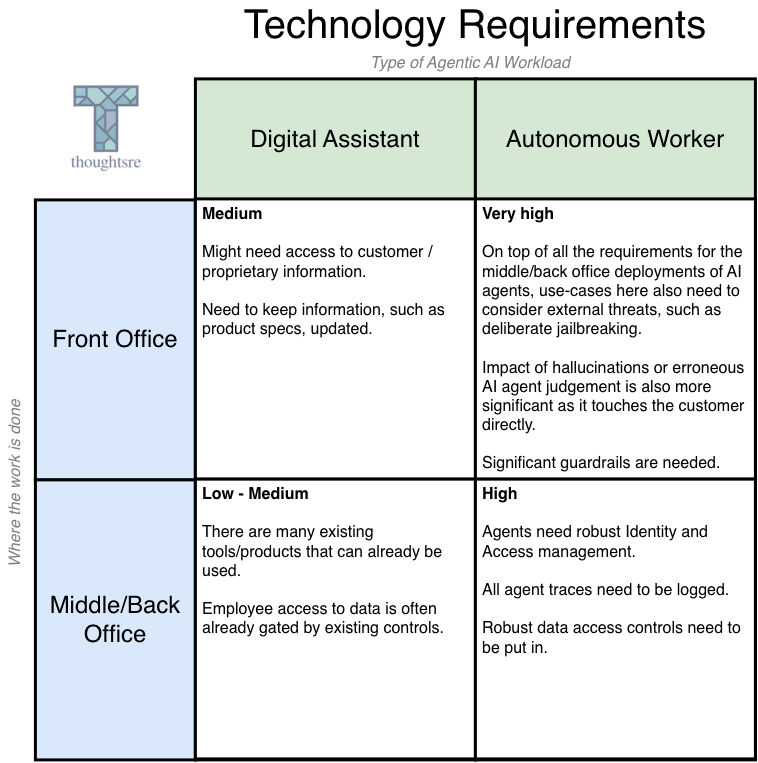
Adopting Agentic AI in each of the quadrants will place different levels of technology requirements on your organization. Companies that have kept up technologically in the last 3-5 years will generally have the capabilities such as fine-grained data access control, to adopt the bottom triangle of the square.
Net Impact Potential
To be honest, this is where the jury is still out for Agentic AI. This is the question that companies are trying to answer, “Does Agentic AI deliver net benefit to my organization?”. The answer will be unique for each organization.
The table below lists down a few considerations.
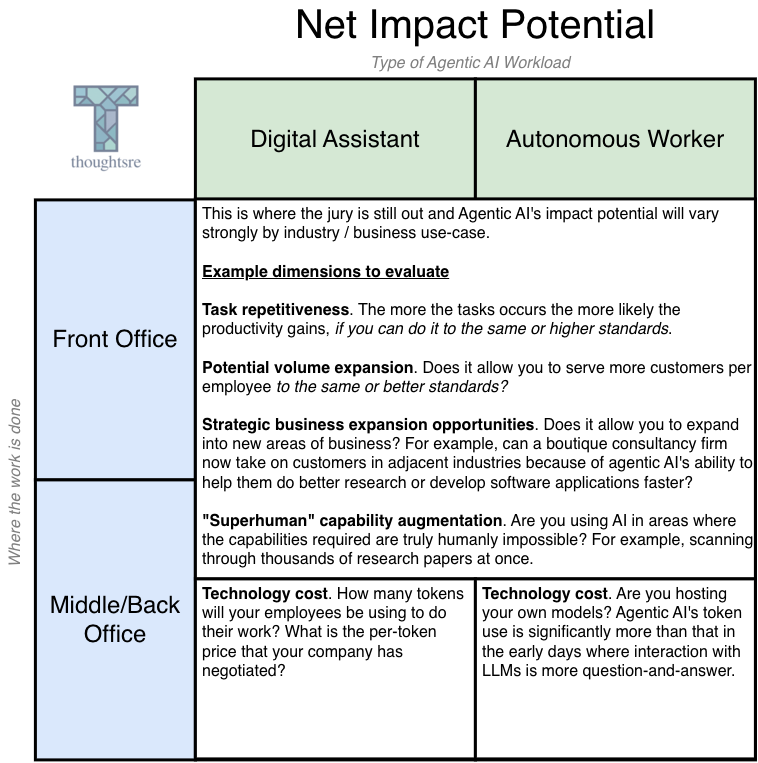
In fact, it is precisely that there is no clear up front answer for this, that this 2-by-2 grid and the prior factors of evaluation are required. By using the prior factors, one can prioritise use-cases that help the organization learn.
Adoption Path
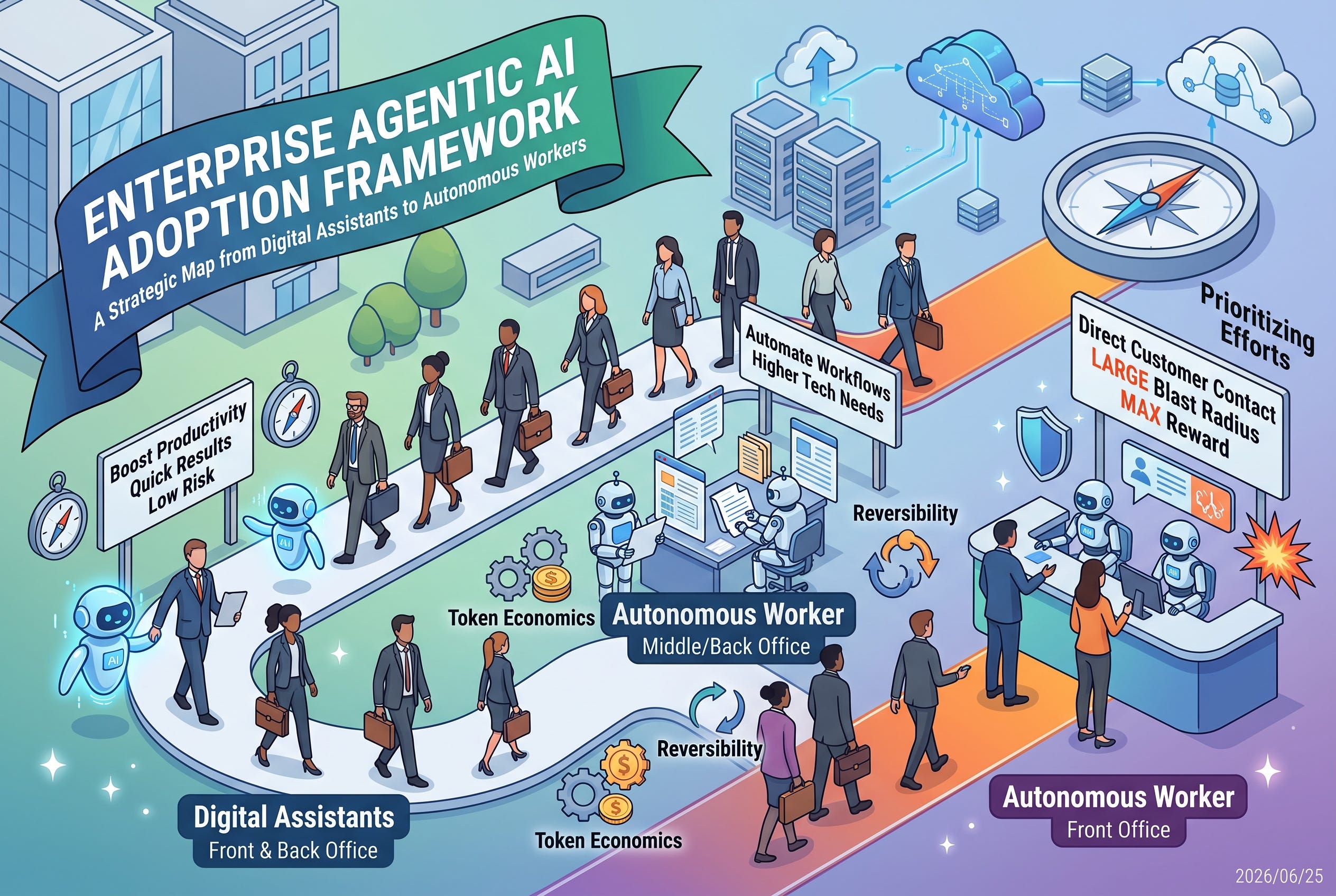
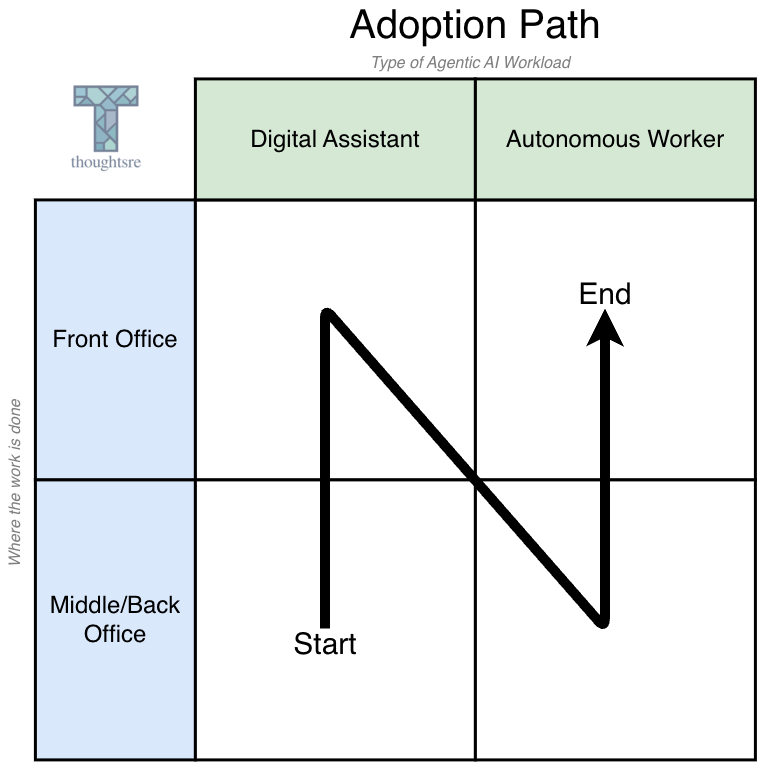
It should come as no surprise then that I recommend the adoption path shown below.
This path, in my mind, allows an organization to quickly see results, pull back if needed, learn the ropes of Agentic AI adoption with minimal risk and educate its workforce along the way.
Conclusion
One could go into a great amount of detail of all the nuances and technical specifications of AI adoption. There is also a lot of noise in the Agentic AI arena now and no one is sure whether these efforts will bear fruit in the end. That being said, I believe that the benefits are real and the question confronting organizations is not whether to play the game or not, but how to play to capture the upside while managing the downsides. And in my mind, the above framing is a nice and easy way to get started on thinking about how an organization should go about its Agentic AI journey.