

On using NotebookLM for learning
If your brain were a computer, it’s like having a massive amount of RAM…

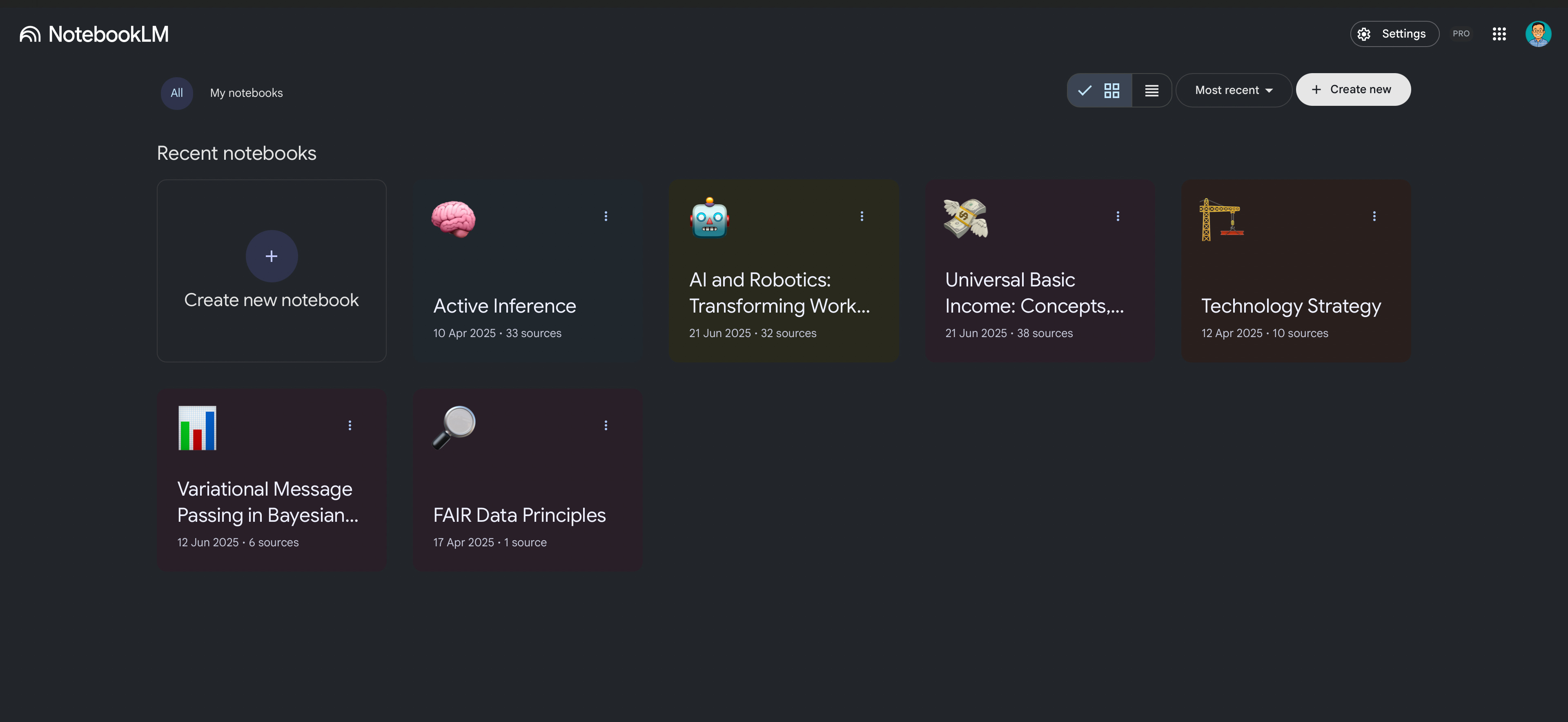
NotebookLM burst onto the GenAI-enabled learning scene with its AI-generated podcast that summarises any topic for you based on digital materials you have on hand. For those who are not familiar, NotebookLM is a web application by Google that allows you to upload text sources like PDFs or websites and then allows you to ask questions about the sources, which it then proceeds to “read” through all of them to find the answers you are looking for. As the name suggests, it’s a tool that is touted for learning.
I’ve been using it for a while for my own learning on areas that are technical, such as Active Inference and more general, like Universal Basic Income. In this post, I summarise my reflections on my use of NotebookLM, tips on using it better and things I wished NotebookLM had.
General reflections
If I were to summarise what it felt like using NotebookLM, I would say this:
If your brain were a computer, then using NotebookLM for learning is like having a massive amounts of RAM.
Of course, the AI-generated podcast wowed me initially. But it was the ability to peruse a curated set of information, hold it in memory and answer your question coherently that made me feel that NotebookLM was really a useful tool for learning.
I was struggling with learning Active Learning which required a very different way of thinking about machine learning that I was used to and involved knowledge in highly mathematical topics like variational learning or Partially Observed Markov Decision Processes (POMDPs). On top of that, the papers were written by neuroscientists and biologists which have a different way of expression compared to mathematicians and computer scientists and were writing about the application of Active Inference in neuroscience, an area which I had very little knowledge or intuition about. There was no way I could hold multiple papers in my head and simultaneously summarise and synthesize the information in them.
That’s when NotebookLM came to the rescue. I uploaded all the papers I could find on Active Inference and I was able to ask questions that perplexed me in some papers to which answers could be found in other papers. The Active Inference community is not very big and the author sometimes assumed that you knew what they were talking about. A memorable moment for me was when NotebookLM demystified the difference between state, policy and parameter inference for me in the Active Inference framework. NotebookLM synthesised information from multiple papers, filled in the gaps from one paper with information from another and presented the information in a coherent manner.
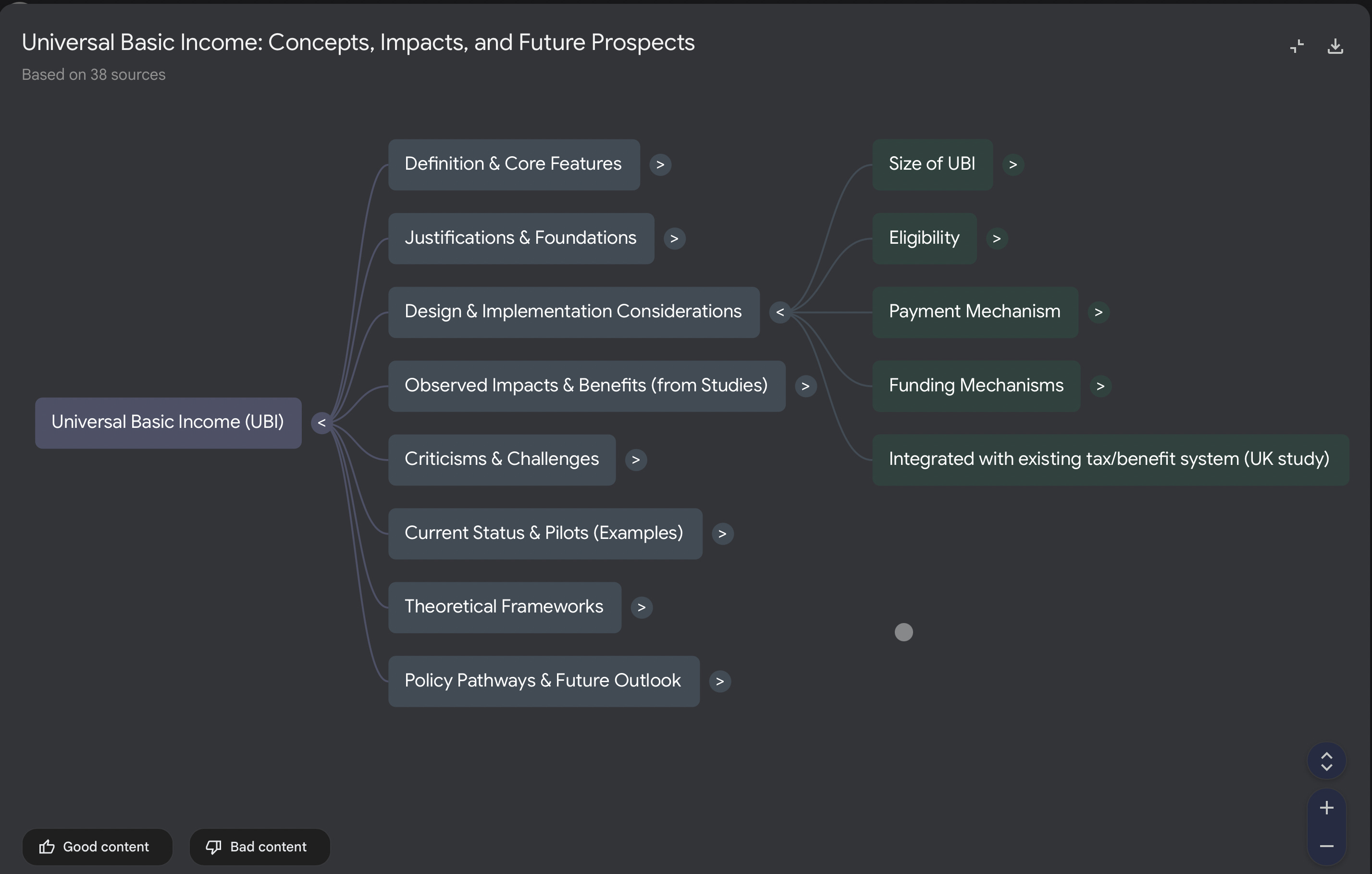
Another really nice feature of NotebookLM is that it is able to generate mind maps for you. Take the mind map generated from my “Universal Basic Income” notebook. It organises the main threads of information for you to explore across all your sources. It is also able to generate other documents like FAQs, briefing docs and timelines. I can imagine a feature like timelines to be useful to people like lawyers.
The latest feature includes generating a video summary. Something I believe visual learners would find useful.
I also didn’t feel like I was a passive recipient of knowledge while I was using NotebookLM, you know, like how you feel like you’re not really using your brain if ChatGPT is simply giving you all the answers. I was an active participant. I had to find the sources of information and I had to think of the questions to ask. It is a product which lives up to its purpose as a study companion.
Usage Tips
Include a “foundational” source for technical topics
NotebookLM can only give you answers from the sources you upload. That’s fine for many cases. However, when you are trying to learn a technical subject and all you have are academic papers, it may not be able to explain things as well to you as you would want it to, simply because it does not have the knowledge. Academic papers often assume understanding in certain foundational topics that you might not have.
For example, I uploaded a copy of Bishop’s seminal book “Pattern Recognition and Machine Learning” when learning Active Inference, and as a result, NotebookLM was able to explain the use of factor graphs in Active Inference better. This is because it had access to the foundational knowledge in Bishop’s book.
Be balanced with your input sources
Again, stemming from the fact that NotebookLM can only know what you give it, take extra care to be balanced with your sources. If all your sources portray a particular topic negatively, then you will only get answers that paint the topic in a negative light, vice versa.
This is especially important when using the “Discover” feature to collect input sources, where you can ask NotebookLM to find information sources for you with a text prompt. For example, when I was using NotebookLM to discover sources on Universal Basic Income, I said “I want to learn about the pros and cons of Universal Basic Income”, instead of “I want to learn what is good about Universal Basic Income”.
Understand that it’s ability to answer you is limited by the LLM that supports it
At the end of the day, the responses you get are still powered by the LLM sitting behind NotebookLM. So do note that there will be some things it cannot do. I realised this when I tried to ask it to perform a step-by-step derivation of an equation. I guess I was thinking too highly of NotebookLM at that point in time.
Feature Wish List
Live data or API access
I wish there were some way to update my sources automatically either by subscribing within NotebookLM or API access. I use Perplexity to keep up with news and I just kept thinking that it would be great if I could pipe some of these articles into notebooks in NotebookLM for me to query later. This is useful if you are keeping track of an on-going event like the Russia-Ukraine war (and you want to use the timeline feature).
Video or image sources
Currently NotebookLM deals predominantly with text sources. Given the progress in multimodal LLMs, it would be great if it could also parse images or videos. In this way, if I see a great talk or lecture, I could upload it and query it.
Better math formatting
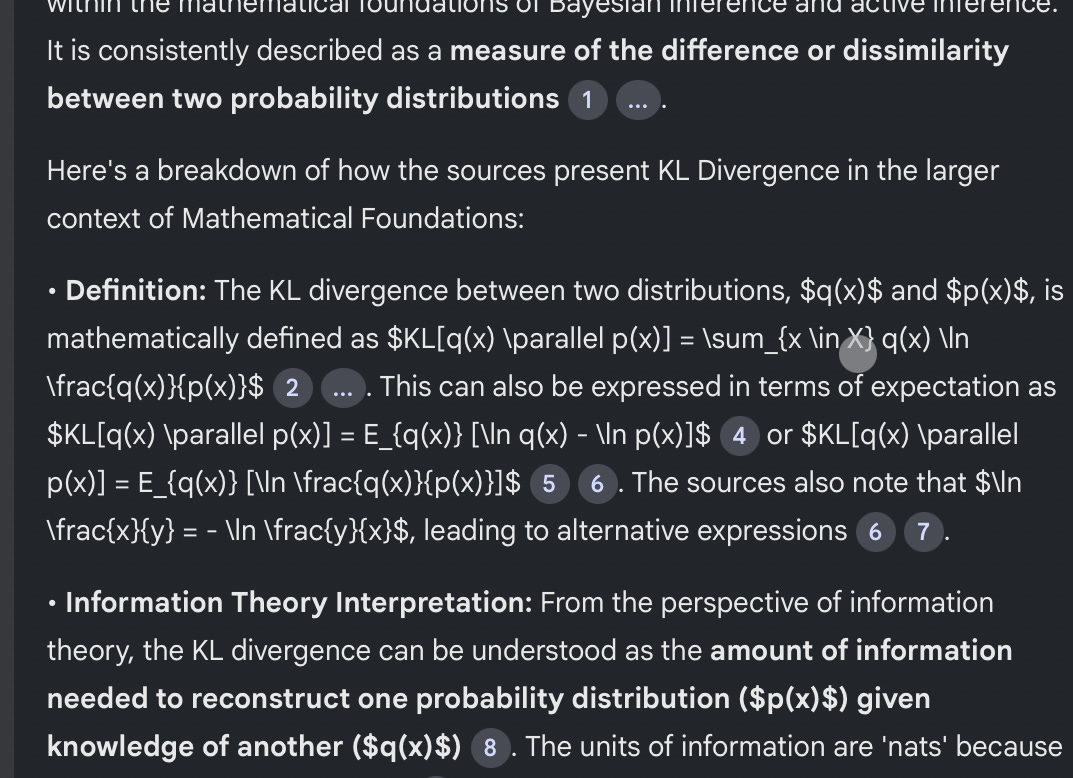
Currently when NotebookLM saves its replies as a note, the math is shown as raw LaTeX. I don’t think it’s too much to ask for the math to be properly displayed, is it?
Handwriting support on tablets
I’m someone who learns better by writing. It’d be great if I could write notes on my IPad in NotebookLM and the LLM can parse my handwritings as well. I know it’s a tall order, but hey, it is a wish list after all…
Conclusion
I thoroughly enjoyed using NotebookLM. Nowadays, when I find myself having too much information to process about a particular topic, NotebookLM is my go-to tool. I hope it keeps on improving as I honestly think that it is useful not just for students but also for professionals.