

The real change is at the man-machine interface
LLMs and GenAI are but an opening act...

Introduction
When I think about changes that are considered “revolutionary” or “phase-changes” from the past, I often find it useful to frame my thinking in terms of interfaces. It is important to notice such changes because when they occur, it often ignites a series of cascading changes that opens up new, not to mention unexpected, ways of working and living and the world is changed beyond recognition at the end of it.
Interfaces…
For example, the mechanization of agriculture was a phase change at the interface of man and his environment. The result was that man can produce much more food with much less effort. What used to be an all-consuming, back-breaking, do-or-die activity for all humankind became an activity which produces so much that in much of the rich world there is an excess of food. Of course the spoils of production is obviously not evenly distributed. But that is not what I am talking about. The release of manpower to other activities drove innovation not only in agriculture but in other areas as well. The ready provision of food allowed man to focus on higher order needs and wants.
Another interface is that of man and his fellow man, the man-man interface. The rise of social networks changed the way people interacted with each other. But it also gave rise to new business models like online advertising and allowed people to participate in the lives of others. Not to mention, along with social networks also came social engineering and other more insidious developments. Safe to say, the post-social network world is also a very different one from before, for those old enough to remember a time when the best one could do to stay in touch is to pick up the phone.
Focusing on the man-machine interface
There are many of such interface changes in history if we care to look but last interface, which is the one I’d like to draw your attention to, is the man-machine interface. The internet represents a change in the man-machine interface. A person can now access information and communicate digitally and remotely via computers. And talking about cascading change, the internet also spawned social networks (a change in the man-man interface).
The iPhone also represents a change in the man-machine interface. Instead of typing on keyboards, people started to interact with machines in a tactile manner. Now, almost all personal electronic devices follow the same interaction model.
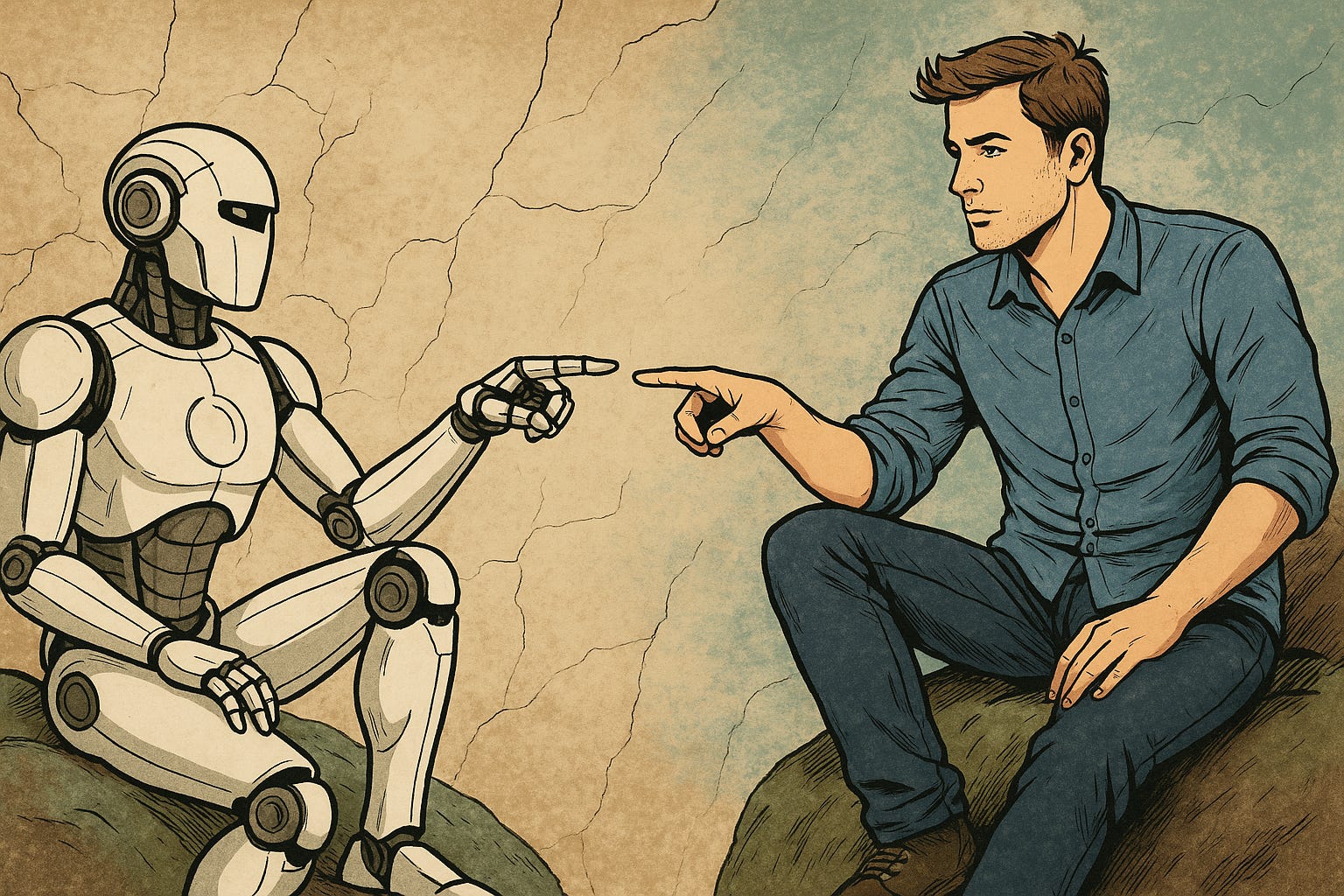
In my mind, another sea change in the man-machine interface is currently getting started and LLMs/GenAI is but the opening salvo. For the first time, humans can interact with machines in one of the most natural medium possible, speech. I’m not talking about speech recognition, but machines that can understand the nuances of our language.
Of course, whether the future of this man-machine interface will still be transformer-based LLMs or Large Concept Models (LCMs) or “Agentic AI” or whatever new-fangled names people come up with, I don’t know. I personally doubt it will be what we see today. But what I am watching out for is what this change will mean in the longer term and how it might change the way we live and work. I’m pretty sure that this will engender new ways of working, interacting with each other (man-man interface) and novel business models that we cannot even begin to imagine.
If we consider also how the fields of AR/VR and wearables are advancing, does it mean that we will be able to speak our minds and let machines take on a lot of the more mechanical work? When we think about this, then we realize how the Google Glass was ahead of its time. While it was an innovation in the hardware space, it lacked the power of understanding that LLMs are now beginning to demonstrate and the interaction with the Google Glass was still unnatural. Now that the software side has caught up, we are seeing a resurgence in interest in AR/VR devices like the Meta Orion. I believe this is an iPhone-like moment where in 10-20 years time, the devices will be somehow wearable. The iPhone-like form-factor of mobile devices will go the way of the Nokia 3210.
The combination of increasingly competent (I won’t use the word “intelligent”) machine learning models with robotics also offers an exciting outlook. At present, the recent explosion of interest in LLMs/GenAI is constrained to the virtual world. But make not mistake, the field is constantly pushing the boundaries and trying to realize itself in the physical world. That will be through robots. Increasingly, we will be seeing robots, aided by flexible and powerful models, which can function autonomously in complex environment. On top of that, building on the foundations of telecommunications, machines can be almost omnipresent (think the Internet-of-Things). Brings to mind Skynet. True. But let’s not be too hasty in judging. Remember, it is almost impossible to foresee the changes that will be brought about by such phase changes. Oftentimes, we can only live it and then discuss it after the fact.
What I’ve discussed is just on the capability side of things. What about new business models applying these new capabilities that might be spawned out of this? After all, this is where rubber meets the road, where actual change in our lives really happen.
Already we are seeing the creative industry being disrupted. Copywriters, website designers, digital artists and many more creative vocations are being revolutionized as we speak. The shock that I had 6-9 months ago was that it was an industry that I had not foreseen been disrupted by AI until LLMs/GenAI. I had always thought, like many others, that it was the more mundane and repetitive work that will be disrupted. It was a lesson to me never to be complacent.
Manufacturing and logistics are also not spared as machines become more competent.
And what about the healthcare or home care industry? What used to be a high touch industry that is expensive for consumers may become increasingly accessible via personal assistants that people can talk to, remote assistance by human operators who can take care of multiple clients at once via AR/VR or even autonomous general purpose robots. Of course, we’d have to tune our definition of “touch” and “contact”. But that could lead to greater accessibility of crucial services.
Not all is well and good, no doubt. Man has the unique ability of using tools for the noblest means and his basest desires. Like how the internet drove the rise of online pornography. I’m sure that the recent advances in LLMs/GenAI will lead to nefarious use-cases that we cannot even begin to imagine. An example is the rise of deepfake scams, made almost indistinguishable from the “real” thing in the virtual world.
Let’s be careful about this…
This is why I believe regulation is important here. Just like how we have regulation to protect our children on the internet. Regulation, constructed by an inclusive and mature community, is an avenue via which the world can take a stand against unbridled innovation. There are a lot of nuances and caveats on this point alone and it is a discussion for another time.
Those who know me would know that I am generally an advocate for innovation. But this is different.
We stand at a point where the minimum capability requirements are being satisfied across various technological (and non-tech) domains at the man-machine interface that would unleash a torrent of change. We don’t need to look far for an example of how such a thing has happened before. The whole big data revolution occurred because minimum requirements in data production (the internet) and data processing capabilities (data centers, efficient CPUs/GPUs and big data frameworks like Apache Hadoop and Apache Spark) were satisfied allowing people to process data on an unprecedented scale. I believe stand at that point right now. We need to be prepared. This is what Bezos would call a Type 1-like decision point.
Overlapping changes
As Vaclav Smil described in his book “Growth”, changes don’t happen linearly and often overlap. They also have a fractal nature to them. I.e. you will have growth cycles within growth cycles. It’s just like how the iPhone man-machine interface change is somehow embedded in the internet revolution (another man-machine interface change) and is an aider and abettor to the social network man-man interface change.
So if you’ve read up to this point, please do not think I’m saying that the world is a clean order sequence of changes. They are all interlinked and embedded within each other. Where the world ends up depends on a balance of forces between these changes. This is why such changes always changes the world in a way we cannot foresee.
Along the way, there are still many technical challenges to overcome. There will be many hiccups. It will seem as if a lot of resources are wasted. What is clear that the recent LLM/GenAI developments have shown that it is possible for machines to understand us. Just like how once man landed on the moon, going to outer space and colonizing other planets is no longer a pipe dream. The next phase of development will go beyond what we see now.
Cascading changes
This change in man-machine interface kicked off by LLMs/GenAI will trigger other changes. One of the changes is advancement in computational efficiency, as witnessed by LLM developments from DeepSeek and also novel computing architectures like those from Cortical Labs. Another change, when we think of how general purpose robots now have a viable market, is in battery technology where you can have high energy density and safe batteries to support home use robots. These are what Christensen would call sustaining innovation that would reinforce the LLM man-machine interface change.
There will also other related changes. One that I can think of is the need for authenticity guarantees with the proliferation of machine generated content. This is where distributed ledgers and NFTs might make a comeback. I can imagine a future where human generated content will be signed on a global blockchain. It will also result in human interaction and performances becoming highly valued.
As machines acquire more and more “thinking” abilities and are able to interface with our lives in a very physical or real way, we might also need to start considering them as “persons” with liabilities. This might spur a change in our legal framework which is a core piece of the man-man interface.
Look beyond LLMs, GenAI or Agentic AI
It might seem easy to dismiss LLMs as less then useful, overwhelmed by all the new models and benchmarks coming out on a daily basis or think that agentic AI’s lack of robustness makes it useless. But that is to see things from today’s perspective and to focus on the wrong things, in my opinion.
The way I see it, LLMs, GenAI and Agentic AI are only the opening act to a broader change in the man-machine interface. And that is what we need to pay attention to rather than specific developments in specific technologies.