

What does it mean to play in the AI space?
What does AI land look like anyway?

Everyone needs to play in the AI space these days. But what does that actually mean? How can we decide how to play, if we don’t know the rules of the game or the size and shape of the field? What does this magical AI land where nothing is impossible actually look like?
Here’s how I think about AI land and how it looks like.
Broadly speaking, I see AI land being made up of three interconnected realms: algorithms, hardware and applications, within which developments in what we generically call AI land exist.
Each of these realms have unique characteristics. But the thing is, activities within each realm affect each other, sometimes constructively and sometimes destructively.
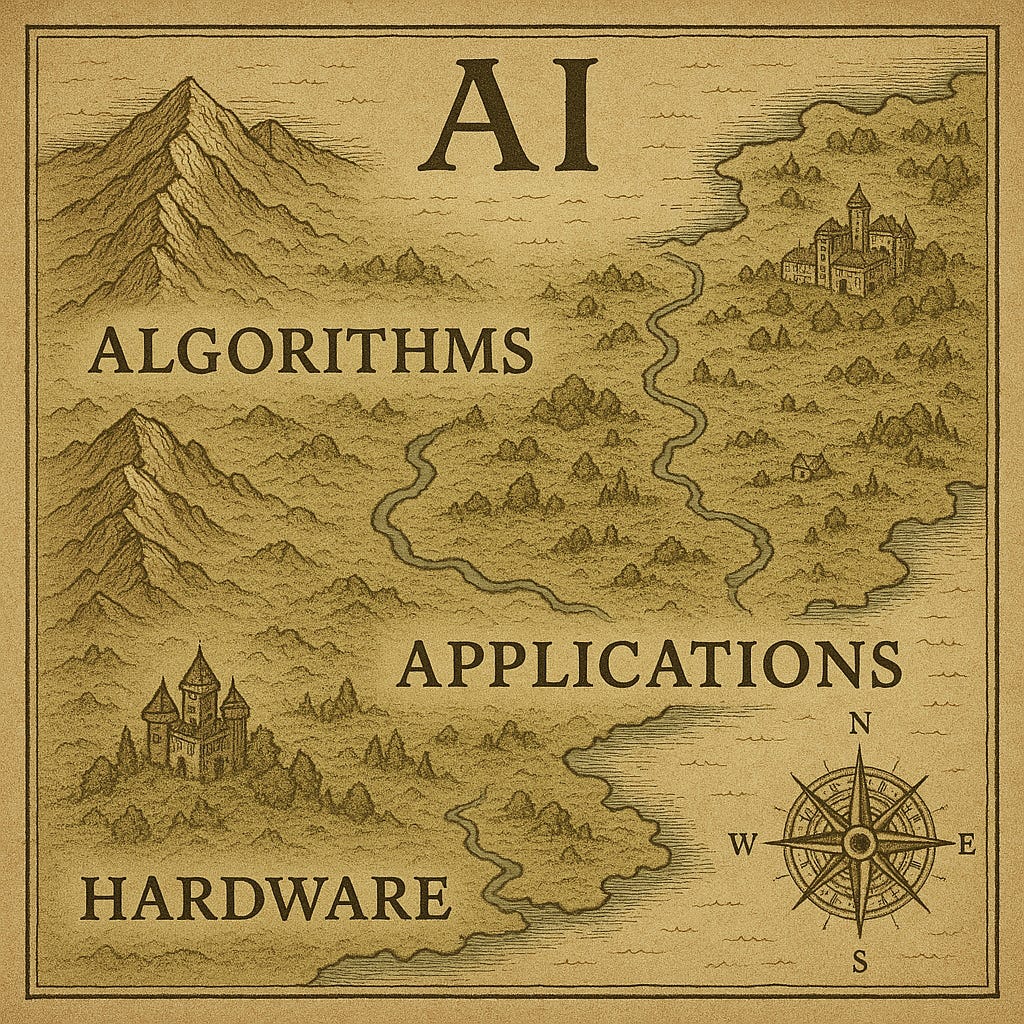
Realm of Algorithms
The realm of algorithms is inhabited by citizens such as the Convolutional Neural Network (CNN), Long Short-term Memory (LSTM), Graph Neural Networks, Bayesian Optimization, the Transformer (who in the last few years has become an all important inhabitant of the algo-realm), etc..
The work carried out here is in discovering new algorithms, improving existing algorithms and constructing the next AI paradigm. The publication of the Transformer architecture and attention is a work in creating new algorithms. Extending the context window of large language models (LLMs) using YaRN is about improving an existing algorithm. Work on Singular Learning Theory and Active Inference might be considered as constructing the next AI paradigm.
Those seeking to enter the realm of algorithms need to have enough data to train their models and the requisite mathematical prowess. The journey into the realm is not long but also not for the faint-hearted.
Realm of Hardware
The realm of hardware is a strongly fortified one which is extremely hard to enter. The entrance fees are high in terms of capital expense and chip making expertise and capabilities. Unless you come with deep pockets to play the game over a long time, I suggest you do not make the journey.
Its main output are computing infrastructure and chips on which AI models are run. Examples include the GroqChip, AWS Inferentia and, who could forget, Nvidia GPUs.
That being said, although the journey is arduous, great rewards are promised to those who dare and can. The barrier to entry protects those who are already in. Case in point, Nvidia’s dominating position in AI.
Realm of Applications
The realm of applications is like a trade and business hub where money, people and resources flow through freely. It doesn’t take much to enter but it is also potentially very lucrative to those who can gain enough scale and volume.
Like a trade hub that is responsible for combining multiple semi-finished inputs into final products to be delivered to end-users, the realm of applications seek to take existing AI techniques and apply them to solve real-world problems. Examples include Google’s landmark detection and v0.dev for AI-assisted frontend development.
The key to being successful in this realm is to have access to customers who are willing to buy your product, domain expertise to adapt AI models to become truly useful for industry participants and the engineering excellence to deliver products quickly.
Interactions of the three realms
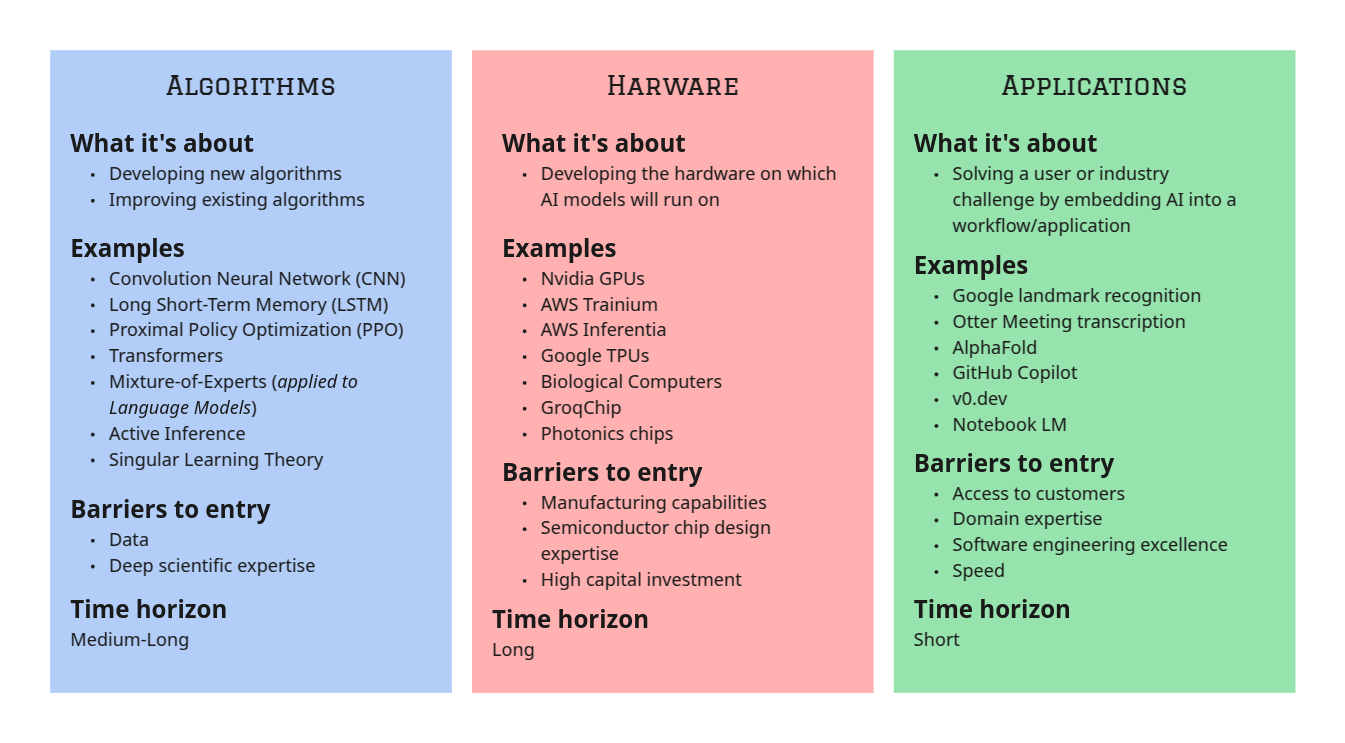
The characteristics of the three realms are summarised below. The thing to note is that the realms are not isolated and are constantly interacting with each other.
Better hardware enables scale for AI applications. While innovative application of AI in real-world problems drives the need for hardware to keep up. For example, the rise of AI fuelled the creation of specialised chips like GroqChip.
The desire to embed AI into end-user applications will drive the need for better algorithms while better algorithms allows developers to be more innovative with the applications they develop. Using the LLM revolution as an example, the rise of LLMs engendered a slew of innovation in the way people do graphic design (Adobe AI), coding (GitHub CoPilot), consume news (Perplexity) and many more.
Algorithms in turn drive demand for AI hardware. Just look at how the demand of Nvidia’s GPU drove the meteoric rise of Nvidia’s stock price. And better AI hardware of course allows faster or more effective training of AI models.
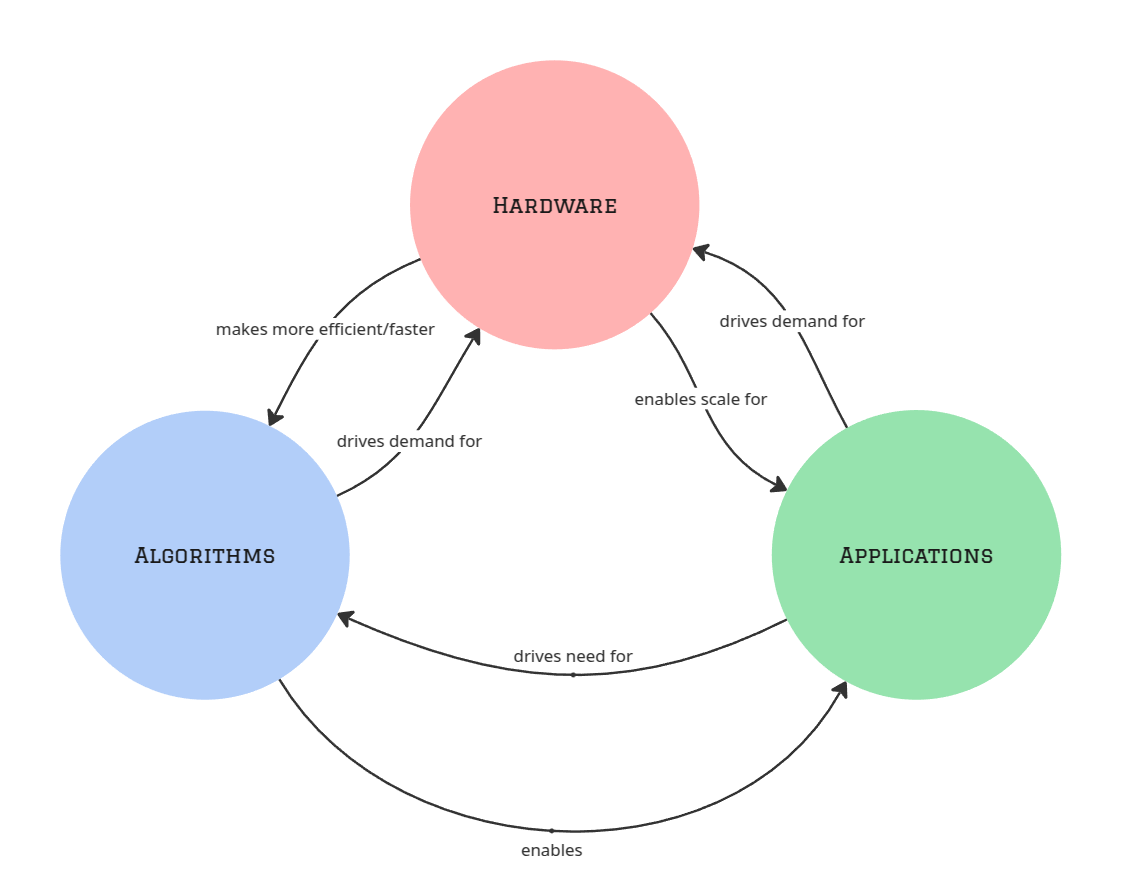
Of course, it doesn’t mean the inhabitants of each land are necessarily friends, while they often are. For example, DeepSeek, an upcoming citizen of the the realm of Algorithms, has negatively affected Nvidia, a Hardware realm royalty, by making LLMs extremely cost and resource efficient.
Realm overlaps and their prominent inhabitants
The three realms not only interact, they also overlap. See the diagram below which shows the prominent citizens of each realm. Note that the list is by no means exhaustive.
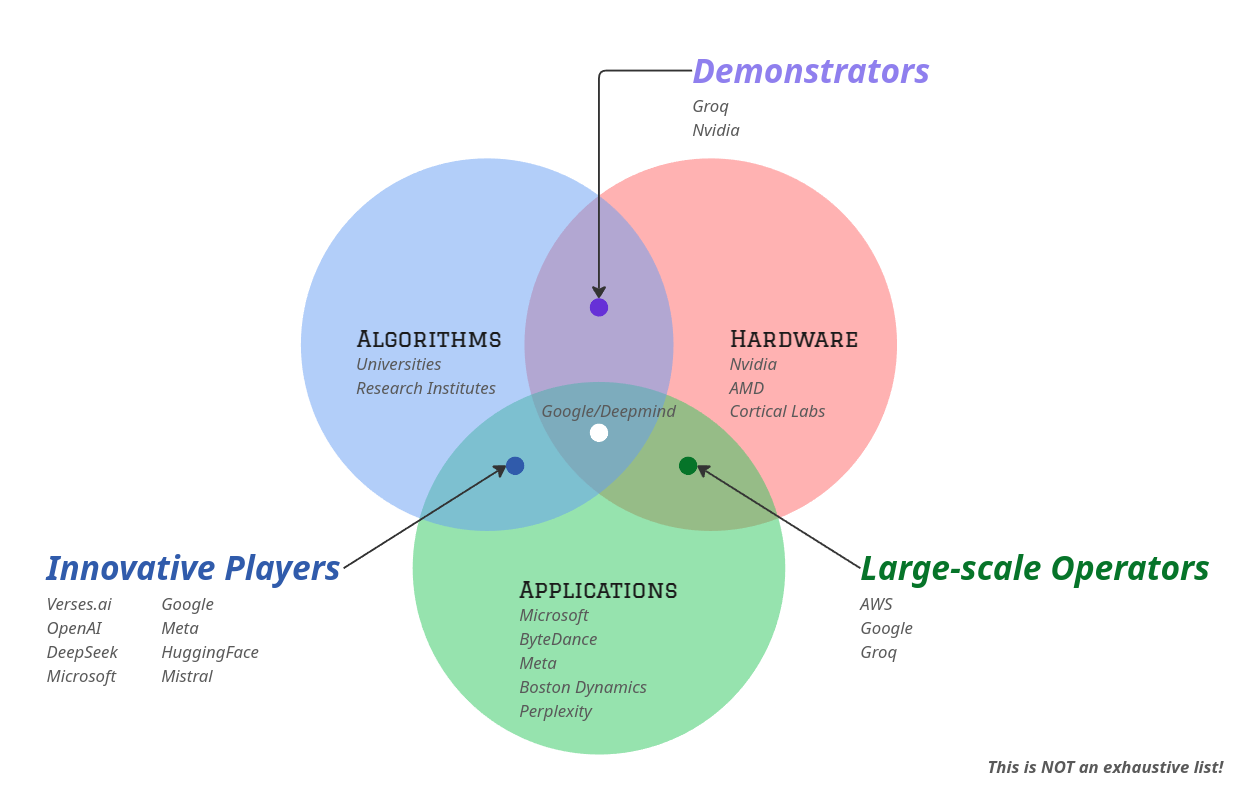
I call the space where algorithms and applications overlap the land of Innovative Players. These are inhabitants who take new algorithms and apply them to solve new problems. Like how OpenAI took the world by storm with LLMs. Of course, as the novel applications become mainstream, innovative players move to become rooted residents of the realm of Applications.
The overlap between algorithms and hardware is where Demonstrators live. Often these are hardware vendors seeking to demonstrate the relevance of their products to the new algorithms. An example is how Nvidia optimized Flash Attention on CUDA.
Then you have the space where residents of the realm of Applications are forced into the hardware realm because of the need to deploy AI applications (or help others deploy) at scale. These are Large-scale Operators like AWS and Google.
Lastly, there is a space where all three realms meet and I don’t have a name for. The only resident I can think of is Google Deepmind. I must stress that this is probably due to my limited knowledge rather than an objective truth.
Conclusion
In conclusion, I see the developments in AI broadly fall into the three categories of algorithms, hardware and applications. While there are significant overlaps in how AI industry participants play in each of the three categories, there are unique characteristics of each category that should inform how we play in the AI space.